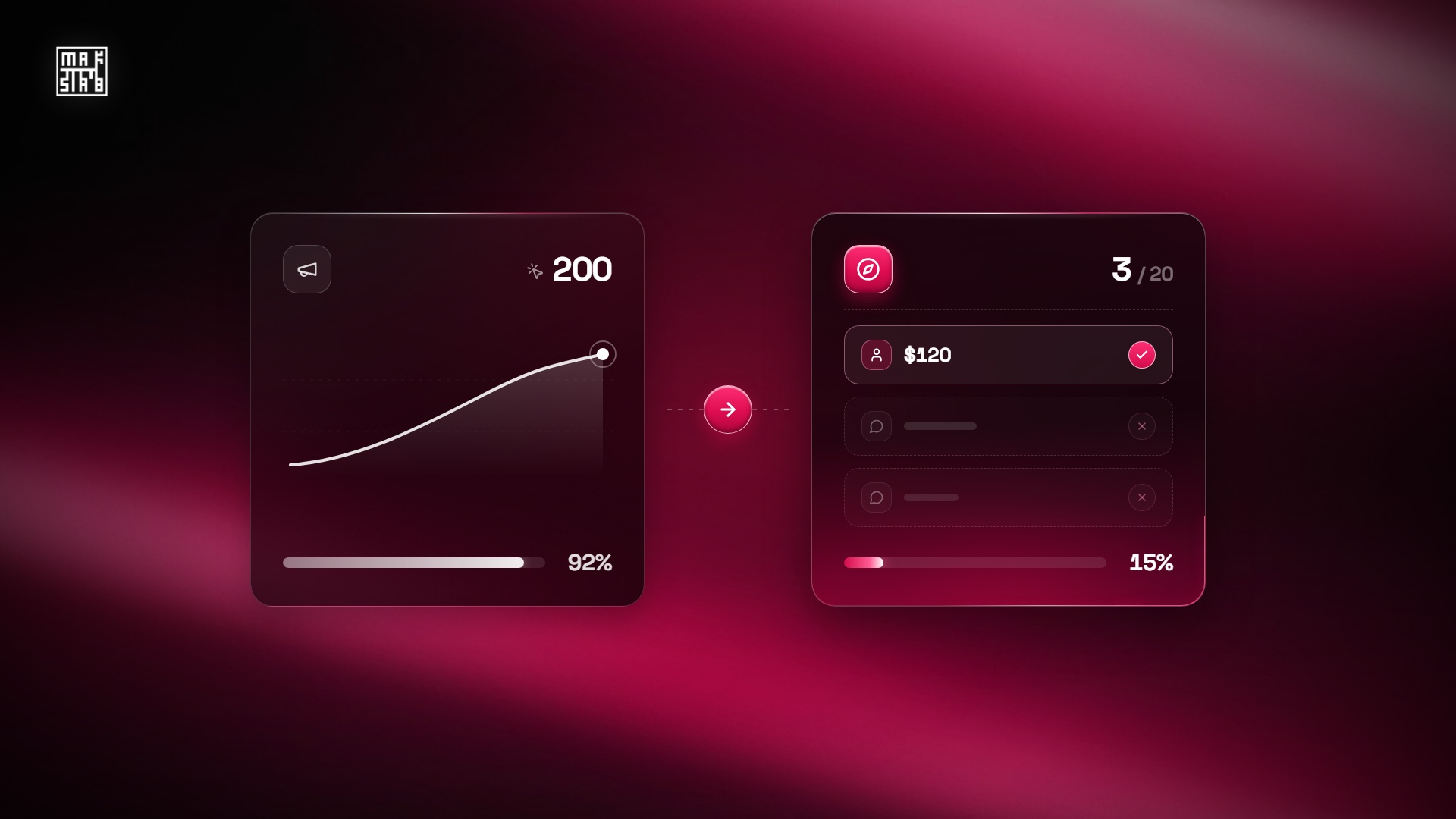
In the interior design studio or service business you run, you open your ad manager at the end of the week and see 200 cheap clicks alongside ten incoming WhatsApp messages. You read through the chats one by one and discover that three people asked for free inspiration photos, four asked for a price per square meter and vanished, and zero consultations or site visits got booked. Looking at the monthly invoice, you realize you cannot tell which share went to the wrong audience and which share died on your landing page or in slow follow-up.
Most business owners expect ad platform dashboards to reveal where money is leaking, yet platforms only count cheap clicks while real waste shows up in your inbox the moment you divide spend by serious inquiries instead of clicks.
Why Ad Platform Reports Hide Where Your Budget Actually Leaks
Ad platforms measure top-of-funnel activity such as impressions, link clicks, and raw chat opens, never whether a visitor has a real project or matching budget. When you optimize campaigns around cheap clicks, the algorithm dutifully delivers curious browsers who make dashboard charts look healthy while draining your monthly budget.
Wasted ad spend does not disappear randomly; it always leaks through three specific doors: an audience that does not match your service, a landing page that fails to convert interest into a request, or a team that responds too slowly to close the inquiry. Most business owners spend weeks tweaking only Door 1 because targeting and creative buttons are the only levers inside the ad manager, leaving the landing page and inbox completely unexamined.
Data from the WordStream by LocaliQ benchmark report analyzing more than 13,000 live campaigns illustrates how wide the gap is between a click and a real lead. All-industry search ads average a 6.64% click-through rate and a $5.42 cost per click, yet average cost per lead reaches $66.69, climbing sharply in high-consideration verticals such as legal services ($131.63), furniture ($106.70), and real estate ($102.51). Because cost per lead equals cost per click divided by conversion rate, chasing cheap clicks often explodes true acquisition cost. That is why building a clear marketing strategy before spending more starts by separating platform activity from commercial numbers, as shown below.
| Measurement Area | What the Ad Platform Reports | What the Project Owner Needs to Know | Cost of Confusing the Two |
|---|---|---|---|
| Traffic Volume | Impressions and low cost per click | Visitors who actually read your service scope | Funding campaigns that attract non-buyers |
| Inquiry Count | Every raw chat open or form submit | Serious inquiries matching your scope and budget | Inflated lead counts hiding high true cost |
| Page Performance | Landing page views logged | Whether mobile load and message match convert | Rewriting good ads while a slow site kills leads |
| Commercial Return | Raw CPC or raw CPL | Cost per serious inquiry against project margin | Burning monthly spend without knowing real ROI |
Step 1 Audit Audience Quality From Your Inbox Not the Ad Manager
Stop guessing inside targeting menus and open the last twenty ad inquiries sitting in WhatsApp or your quote inbox. Read the exact questions prospects ask and sort each conversation into three clear buckets: qualified fit, curious browser, or wrong fit. Twenty real chats expose targeting waste far faster than any platform chart.
Visual and high-ticket services such as interior design and fit-out studios routinely fall into the curiosity trap on social platforms. Unlike Google search, Meta ads interrupt people while browsing; multi-vertical benchmarks put median Meta lead-form conversion around 8.54% with a median cost per lead near $27.39, rising toward $62 in specialized services. When a homeowner sees an attractive living-room photo on Instagram, they tap out of Pinterest-style curiosity and message for free ideas or rough square-meter pricing with no active renovation timeline.
Spend fifteen minutes today running the twenty-message inbox triage using three ordered steps.
- List the last 20 incoming inquiries from your active campaign on a single sheet and copy the exact opening question each person asked.
- Tag every message as Qualified Fit (states real project scope, location, and plausible timeline), Curious Browser (asks for free photos or bare unit pricing without context), or Wrong Fit (outside service area, unrelated need, or incompatible budget).
- Tally each bucket out of twenty. If Curious Browsers and Wrong Fits exceed half of your inbox, Door 1 is your primary leak, and your ad copy needs explicit qualifying cues specifying project type or service scope so non-buyers self-filter before clicking.
Steps 2 and 3 Audit the Landing Page and Follow-Up Speed
If clicks look strong while serious requests barely trickle in, or if qualified inquiries stall before booking a consultation, your budget is leaking at Door 2 (the landing page) or Door 3 (follow-up speed). Slow mobile pages, generic homepages, and multi-hour response delays silently turn good ad clicks into apparent campaign failure.
Think with Google mobile benchmarks establish that 53% of mobile visitors abandon pages taking longer than 3 seconds to load, with bounce probability jumping 90% when load stretches to 5 seconds. Even visitors who survive a slow load frequently bounce when an ad promising a specific consultation dumps them onto a cluttered general homepage. Test Door 2 on cellular data with five direct questions: does the opening headline match the ad promise, is the service scope obvious above the fold, is there a realistic expectation or price framing, does credible proof appear quickly, and does the request form ask for just three essential fields rather than a ten-question interrogation?
Once your page passes, audit Door 3: response speed and consistency. Landmark Harvard Business Review research examining 2,241 firms and 1.25 million web leads showed that waiting 30 minutes instead of 5 minutes drops lead qualification odds by 21 times, while contacting leads within one hour makes qualification nearly 7 times more likely than waiting past an hour. Run a plain three-column follow-up sheet for ten days recording arrival time, first-response delay, and final outcome. You can see how post-click speed and reply delays compound in our breakdown of why clinics lose bookings despite ad spend, where the same operational leaks apply across quote-based services.
Step 4 Calculate Cost Per Serious Inquiry Instead of Cost Per Click
Divide your total monthly ad spend exclusively by the count of serious, qualified inquiries that match your service and budget, ignoring raw link clicks and curious messages. Cost Per Serious Inquiry is the only metric that reveals whether a campaign can actually generate profitable revenue.
Both agencies and founders routinely get trapped optimizing for Cost Per Click because it looks neat and inexpensive inside the ad manager. Your real waste formula takes just two lines: sum total ad spend over thirty days, then divide strictly by inquiries tagged Qualified Fit during your inbox triage. Once you calculate that single number, a counter-intuitive truth emerges: the campaign with clicks costing four times as much often delivers serious clients at less than half the real price.
Tracking Cost Per Serious Inquiry also transforms technical setup. Instead of training the ad platform solely on link clicks, connecting verified quote-form completions back to the ad account teaches the algorithm to find buyers who resemble your serious inquiries rather than casual clickers.
Step 5 The Decision Matrix and the One-Change-Per-Week Rule
Match your dominant symptom directly to its likely waste door, apply one focused fix, and hold steady for seven full days before touching another variable. Rewriting targeting, creatives, landing copy, and sales scripts in the same week destroys your ability to tell which adjustment lowered your real inquiry cost.
Impatient daily tweaking is one of the most overlooked sources of wasted spend because it resets platform learning and blurs cause and effect. Use the diagnostic matrix below to isolate the right first move and measure cleanly.
| Dominant Symptom | Probable Waste Door | First Priority Fix | Measurement Window |
|---|---|---|---|
| High clicks with near-zero messages or forms | Door 2 Landing Page & Speed | Route traffic to a fast, matching service page with a 3-field form | 7 full days |
| Many messages, mostly curious or wrong budget | Door 1 Ad Hook & Targeting | Add explicit qualifying language in the ad and tighten geography | 7 full days |
| Serious inquiries arrive but zero consultations close | Door 3 Follow-Up Speed & Script | Hold first replies under 15 minutes with a 3-line qualifying script | 10 full days |
| Very few clicks and high CPC from day one | Ad Creative & Core Hook | Rewrite the opening hook around one urgent operational pain | 7 full days |
When your audit reveals leaks spanning a slow website, disconnected tracking, and scattered ad management at the same time, patching each piece through separate freelancers usually creates another round of blame. You can review our foundation and monthly management packages to see how one accountable team connects fast landing pages, tracking, and ad strategy under transparent fixed-scope terms.
When to Pause the Ad Immediately Instead of Tweaking It
Pause paid spend immediately whenever your mobile landing page fails basic speed or form checks, when nobody on your team can reply to inquiries within an hour, or when forty qualified clicks produce zero interest in your core offer. Campaign tweaks cannot rescue an unready operation or a misaligned offer.
Honest advisory means naming clearly when neither sharper targeting nor a faster page is enough. Three unmistakable warning signs tell you to stop spending immediately and fix the underlying foundation first.
- Qualified clicks reach a fast, clear landing page that mirrors the ad promise, yet zero visitors submit a request because the offer itself feels vague or overpriced relative to local alternatives.
- Your inbox regularly leaves inquiries unanswered for more than two hours, or ads run through late evening hours with no fast intake form or response coverage.
- Campaigns run without testing the mobile request form on cellular data and without verified conversion tracking, guaranteeing blind spend with no reliable feedback loop.
A disciplined pause is not marketing defeat; it is the quickest way to protect cash flow. Before pausing, export your last twenty messages and baseline numbers, repair the single broken gate on an isolated staging preview first, and relaunch calmly at a controlled test budget.
Frequently Asked Questions
How do I know my ad budget is truly wasted rather than in a normal testing phase?
You are looking at structural waste when clicks flow steadily for 10 to 14 days while serious inquiries stay near zero, or when Cost Per Serious Inquiry exceeds what a single closed project can profitably sustain. Normal platform learning stabilizes early; persistent post-click drop-off signals a broken door.
What is the practical difference between Cost Per Click and Cost Per Serious Inquiry?
Cost Per Click measures how cheaply an ad buys a tap, including casual browsers who never intend to hire you. Cost Per Serious Inquiry divides total spend strictly by qualified leads matching your service and budget, making it the only trustworthy commercial efficiency metric.
Should I pause my ads right away if they produce no clients after two weeks?
Avoid blind pausing before completing the 20-message inbox triage and checking mobile load and reply times. If the ad is delivering relevant clicks that fail on a slow landing page or delayed WhatsApp replies, pause only long enough to seal that broken door before resuming.
How many incoming messages do I need to judge ad targeting accurately?
Twenty real inquiries from your active campaign provide a reliable baseline audit. Sort them into Qualified Fit, Curious Browser, and Wrong Fit; if more than half fall outside your real buyer profile, add qualifying filters to your ad copy before spending another dollar.
Is wasted spend usually the media buyer’s fault or a disconnect between site and sales?
Most ad waste stems from operational disconnection rather than one person’s effort. When a media buyer chases cheap clicks, a separate developer delivers a slow generic homepage, and reception replies hours late, performance stalls until one coordinated system connects all three doors.
Your Next Practical Step to Stop Wasted Ad Spend
Your next decision takes thirty minutes and costs nothing. Stop grading your campaigns by cheap dashboard clicks, sort your last twenty inbox messages into three buckets, calculate your true Cost Per Serious Inquiry, and repair the single leaking door for one full week before adding any new ad budget.
If you want Maksab’s technical and marketing team to audit your ad campaigns, mobile landing page, and inquiry flow together and deliver a clear fixed-price action plan within 48 hours, request an ad-waste audit via our quote form or message us directly on WhatsApp.